

Staying isn’t always strength; leaving isn’t always failure
Thing #13 of 50 Things at 50

If the flight and freeze stress responses had a spokesperson, you’re reading the words of the Flo-from-Progressive version of the amygdala.
Hi, I’m Amanda, and I can’t always trust my impulse to run when things get hard, or my inability to let go when hanging on is no longer a good choice. A common problem, yes, but also shaped and reinforced by things I didn’t choose. It’s instinct x trauma, and my nervous system is the lovechild.
This shows us in all kinds of ways, from the “girl, you need therapy” kind to the “that’s the Benny Hill you’re going to die on?” ridiculous kind. It shows up in relationships, when I’m working on projects, in my belief systems and perspectives, with old goals and with new special interests, and in my need to prove myself. I didn’t make the rules; I just follow the chemtrails in my brain to their inevitable conclusions.
The problem is I care too deeply. The problem is I’m a perfectionist (until I’m not). The problem is I get fixated on an idea and I can’t pivot. The problem is if I connect, they’ll disconnect. The problem is they don’t understand like I do. The problem is my fantastic imagination likes picturing the worst-case scenario in convincing detail and now that’s the only possibility. The problem is I have attachment issues.
I’ve got 99 problems, and they’re all in my head.
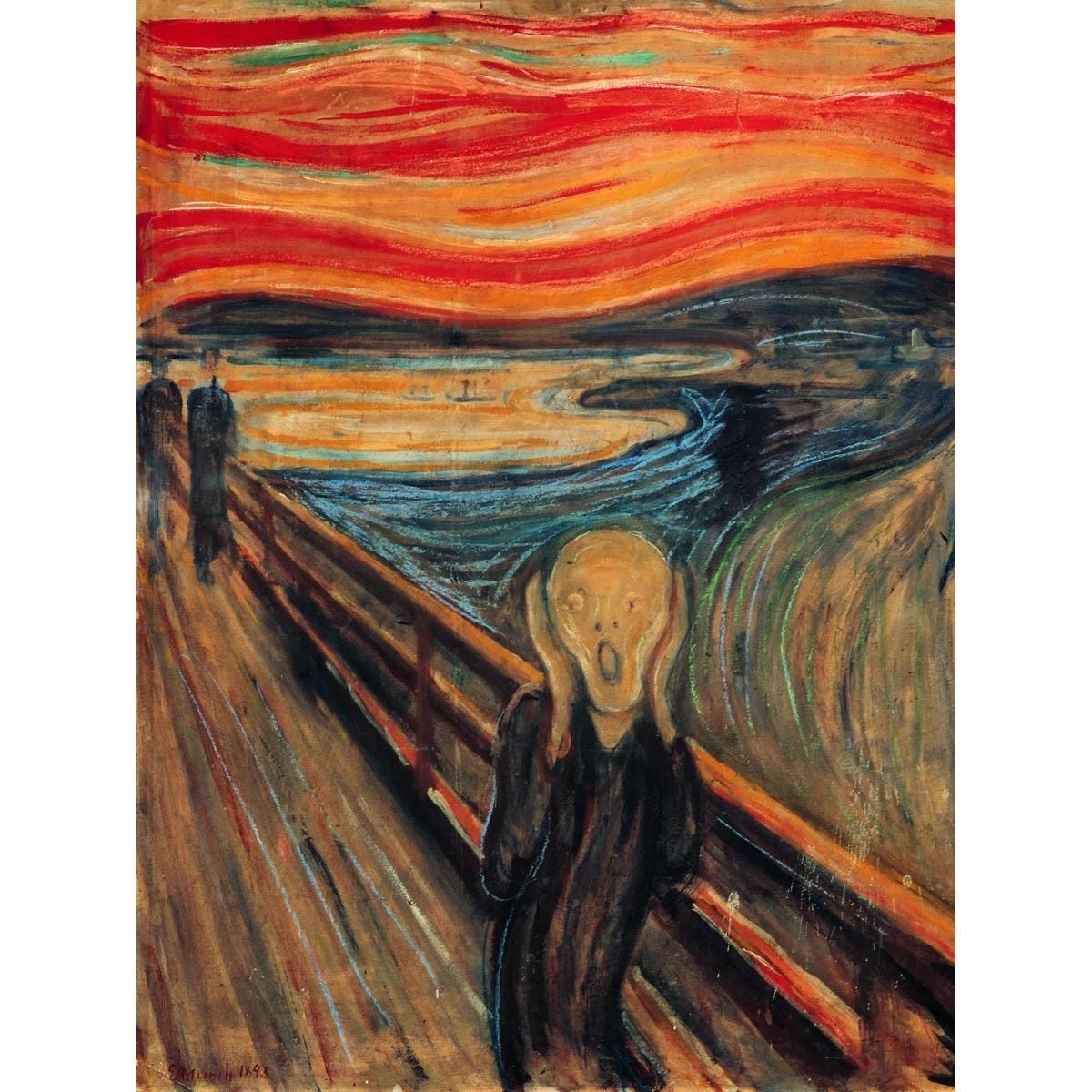
THE SKY IS RED & I’M ON THE BRIDGE SCREAMING (on the inside)
I’m overheating, my head is aching, and an internal pressure has built inside me to the point I’m about to explode. This is how I feel right before a moment when I want to “quit” and walk away.
How do I sit with an emotion so big it looms over my mind, threatening to crush me from the inside?
It’s kind of like when a cartoon character churns its legs in circles before moving forward when it wants to run. All frantic urgency but no progress. Not emotionally. Cognitively, I can hold nuance. I can say I know this or I understand that. But in my body? The sirens are sounding, the lights are flashing, and I’m stuffing every justification for escaping into a getaway bag.
But leaving often gets me nowhere. Not when it comes to maturity.
How do I not abandon myself when everything inside, and so many experiences have taught me, that I’m in danger, that I’m about to be rejected or disappeared again, that I and my work will be made irrelevant because other people are analyzing all my mistakes and imperfections?
THE RIVER RUNNING UNDERNEATH
When you’re a child, you don’t have a lot of control. This was compounded for me in dramatic (but not all that uncommon) ways through sexual assault, early rejection, emotional abuse through intentional withdrawal, etc. My past taught me that giving up and leaving puts me in some kind of control. I can remove myself emotionally before the other person/people can discard me. As soon as I feel any kind of emotional distance, I’m starting to make my exit strategy because I was trained to know this was punishment. I struggle with those who are more reserved emotionally, as this was a sign of abandonment, manipulation, and cruelty.
But the skills that I developed to survive and adapt, and that now put me on high alert, aren’t always reliable. They lead me to make radical decisions based on strong but primitive emotions. And then regrets frequently follow in the wake of those decisions, bringing with them a despair that I will ever change, be competent, be mature, be… better.
EXIT, PURSUED BY A FEAR
I remember a moment in the first couple of years of my marriage when I was talking to my husband in bed. The conversation was difficult, and I had that impulse to run away, to give up, but I deliberately chose to stay present. I recall thinking “I’m changing,” and “If I leave right now, I’m sabotaging our relationship, and this matters too much to risk that.”
Sticking it out is so hard. I want to be reasonable and make sound decisions based on a fair assessment. I want to give others the benefit of the doubt and not flatten them - or myself - into a villain. So my wonky-wired electric meatloaf tries to force clarity on a situation before I even have all the information, before I have a deeper conversation with the other person. My brain must make it make sense. Even if it’s too early.
Meanwhile, the rest of my nervous system is doing that five-alarm fire dance, trying to exit uncertainty as quickly as possible. Warp nine, Mr. Spock.
Protective disengagement is a shoot-first, ask-questions-later deal. Those questions are, “Is the problem the thing, or my experience of the thing? Is this a time to give up because this thing is no longer aligned, or a time to let go of control because that’s what is throwing me out of alignment?”
BUT ALSO, DO I HAVE TO LET IT LINGER?
I also stay long past when I should. This is also based on fear: of failure, of looking like I don’t care, of uncertainty elsewhere (that “better the devil you know” syndrome). Or I’m pretending things - or myself - haven’t changed, or I’m trying to live up to other people’s expectations (at least, my assumptions of their expectations).
That baseline dedication to being “reasonable” means the meatloaf will gaslight me into complacency. “You’re too sensitive.” “That’s not what’s really going on.” “This is your fault, but it’s also your responsibility to see it through.” “No one else has these problems or sees these signs. You’re unstable. Delusional.”
So I do stick it out. I collect all the red flags I pass like I’m some kind of clueless relational toxicologist. “Oh, another excellent specimen of manipulatus coercitus. This area appears to be especially conducive as breeding grounds.”
Funny, though. Somehow, it’s always some part of me that gets pinned up for display as an example of complicity or gullibility. “See, kids? This is what happens when you trust the best intentions of others over your own gut feelings.”
I’ve stuck it out through egocentric pastors, narcissistic bosses, abusive friendships, toxic boards and teams, projects and ministries long past their season of effectiveness, and almost the first season of Parks and Recreation. “It gets better, I promise,” will be the last words I hear from a two-star hotel employee as I descend into a lava pit that was labeled as a natural hot spring.
PUTTING BABY IN THE CORNER
That pathological allergy to ambiguity resists having to wait for answers. To sit patiently long enough to get to the source of my discomfort makes me want to crawl out of my skin. What makes it even trickier is that my instinct to “fly, you fool” may not be wrong. Just too early in the game to be a healthy judgment call, the kind that forfeits the game.
So it’s time for a different game: 20 questions with myself. (Actually, three.):
Where is this coming from, fear or truth?
Am I trying to escape a feeling or honor a reality?
Am I acting out of self-respect or self-protection?
And a few complete-this-sentence exercises:
If I stay, I’m afraid that…
If I leave, I’m hoping that…
What I actually need right now is…
I hate homework. But I have to sit myself down in this corner and think about the repercussions of my intended actions (or inactions).
IT’S NOT ME, IT’S ME
I’m asking myself other questions, too. Ones that don’t have clear answers.
As someone who thrives at the intersection of momentum and meaning, how do I slow down long enough to have more balanced decisions without breaking stride? How do I not assign values too early in a conversation, a project, or a relationship? As someone who tends to be all-or-nothing, how do I give of my incredible amount of energy, passion, and creativity without becoming too invested or controlling?
I guess I’m asking, “Is it possible to be me and still be able to be flexible? To be engaged without being possessive?”
Because I can’t control other people’s intentions or motivations, their actions, or how they perceive my words or actions. I can’t control the outcomes of my work, just the effort I put in and the quality of what I produce.
I can’t even control my default settings. But I can know myself well enough to adjust for my quirks. I can keep gently tugging on my meatball’s leash to guide my head back to focusing on who I want to be and how I want to behave.
WHEN THE SCARS ALIGN
I’ve kind of had two threads running through this essay. One is about the impulse to give up and the reluctance to let go, the other is about healing enough to not reopen my own wounds through acting out old patterns.
Man, it’s really hard being so publicly mentally ill. But this is what it’s really like being me, being inside my head. And while it’s alienating, I don’t think I’m alone. So I put this stuff out there in the hopes of connecting.
Back to the issue of patterns. I’m still trying to recognize them when they surface, and to name them. I suppose it’s a bit of magical thinking to believe that knowing the true names of those subconscious drivers and hardwired habits will give me some mythic mastery over them. Honestly, I’d settle for some simple potty training.
Because it’s about practicing over perfection.
My husband has a constellation of scars on his arms from an ATV accident when he was a kid. They are fascinating to trace and inspect when I notice them. A lot of the time, I don’t, and he long ago “forgot” them in the sense of acute awareness morphing into natural acceptance. He let go of them being a defining characteristic of his appearance (if he ever did in the first place).
I’m looking forward to the time when I’ve healed enough to not let my scars define me, to when my amygdala’s responses morph into quiet acknowledgment instead of knee-jerk overreaction.
In the meantime, can I interest you in wasting energy with an extreme emotion bundle from the brain’s temporal lobe?